
by Genevieve L. Asenjo
“Isa ka Pungpong nga Rosas” (“A Bouquet of Roses”) is memory & threshold: a modern love story of one woman’s trauma with men & her way to healing brought by a companionship of a queer acquaintance, a potential lover. It reckons with old-age and patriarchal notions of virginity — there has to be blood on the first sexual encounter — and psychological ghosts of sexual abuse manifesting as self-abasement. This is the core of the 1997 Palanca award-winning short story of the same title by retired University of the Philippines Visayas (UPV) professor Alice Tan Gonzales, adapted into a distilled screenplay with crisp dialogue in Hiligaynon-English by another award-winning UPV professor Kevin Piamonte, to the directorial debut of assistant professor Julie Prescott. With seasoned cinematographer, editor, and colorist Ruperto Quitag, together with Gian Niño Genoveza, this film in 43.34 minutes is elegant, tender, and polished.
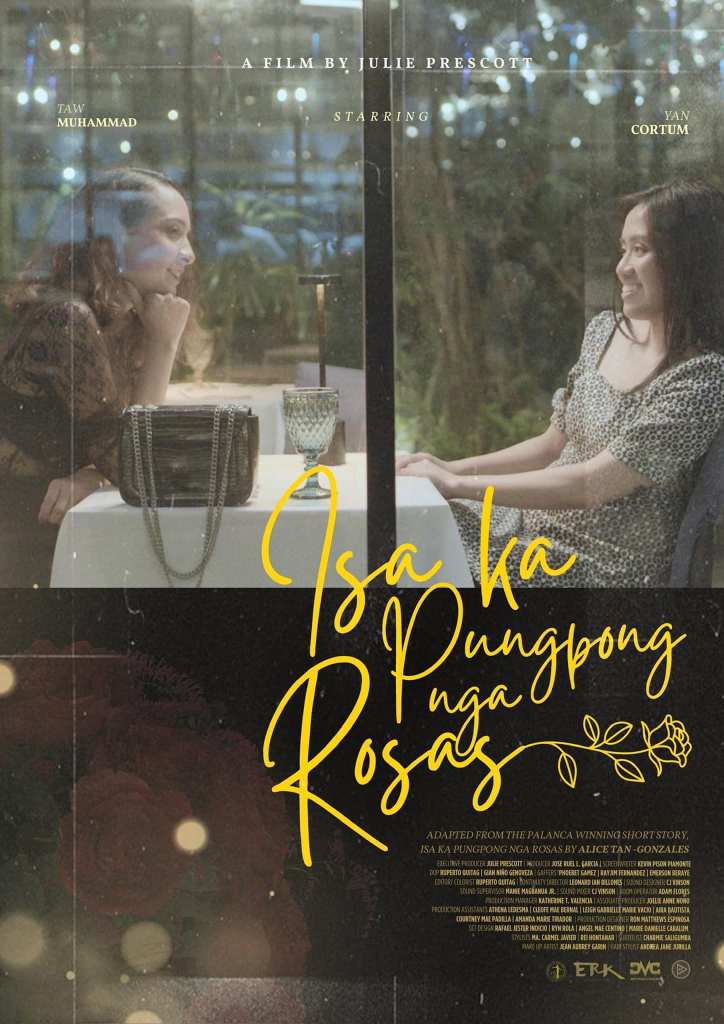
This story-to-screen event is special to me. “Isa ka Pungpong nga Rosas” is an all-time favorite, not only as a Hiligaynon short story but as a Philippine literary text that I translated to Filipino in 2013, “Isang Pumpon ng Rosas.” Tan Gonzales is one of my former and favorite UPV professors and a major influence. That this film is almost perfect in its attention to detail and deployment of visual language to its choice of actors — Alyanna Cortum as Gemma, the cisfemale protagonist, and Taw Muhammad as the queer Claire —made me happy and proud. Muhammad, most especially, is memorable: physically gorgeous with vocal qualities that rendered her natural and convincing performance of Claire as a decent, sensitive, and enlightened person. This is true of the short story’s characterization and representation, and it is an important element as it busts stereotypes.
That this film came out from UPV’s powerhouse of writers and filmmakers and Ilonggo talents is fitting. A must, even. Timely and relevant as we celebrate June as Pride Month, and the SOGIE Equality Bill remains to be legislated. We cannot underestimate the conservatism in this country.
“Isa ka Pungpong nga Rosas” moves beyond metaphor. It confronts hidden and slow violence of our oversimplified and often inaccurate generalizations that can be harmful, such as a woman’s value is based on the condition of her hymen. The original story is a flashback; remembering as meaning-making. It is told from the point-of-view of Gemma and opens on the evening of her birthday, which her boyfriend Larry forgot. This propels the causality of the story that leads Gemma to a birthday dinner date (instead) with Claire. Gemma & Claire’s life stories unfold through dialogue —kuwentuhan. The anticipation lies in: will something intimate happen between them tonight, as Claire accompanied the mildly drunk and vulnerable Gemma home? You need to watch the film. Demand for more screenings.
Piamonte’s screenplay sets it in the present. Viewers have the immediacy, and intimacy, to the whole visual storytelling. The narrative arc is clear. And how did Piamonte and Prescott handle the flashback scenes? Gemma’s remembering, the subplots, are filtered and dramatized as hauntedness. They pop up exactly during Gemma and Claire’s dinner conversation as a necessary backstory to understanding Gemma’s current mental state. This is a common technique that can be intrusive. Here, however, is a handling of narrative time toward an evocation of empathy. In Prescott’s direction, the angles, composition, framing, shots, lighting, and sound remind viewers of the brokenness of the characters, their lot of a beautiful mess, and this very moment is their breathing space. No judgment, just listen. No jumping into bed, just stay — for a while; tomorrow never ends. Prescott’s directorial style is subtle and sleek. Accompanied by a tempered color grading, the film exudes balance. This one knows its target audience: Gen X down to Gen Z. Boomers are welcome.
I also like that this is your urbane Iloilo City. Ilonggo filmmakers have long produced, and thrived, in documentaries, shorts, and full-length films showcasing relevant historical and social realities. This film, characterized by middle-class salaried professionals with the privilege of dining out in a restaurant like Jardin to reconcile with past lived experiences and acknowledge another form of loving present then and now, is a welcome contribution. Advertised as “a short film about women by a woman,” this is an excellent tribute to Ma’am Alice. I congratulate the whole production team, the UPV Division of Humanities, ERK Film Production, DMC, and Prime Media Hub.
“Isa ka Pungpong nga Rosas” premiered last June 15, 2024, at the UPV Cinematheque, Iloilo City campus, with three public screenings.

 Balay Sugidanun