
by Genevieve L. Asenjo
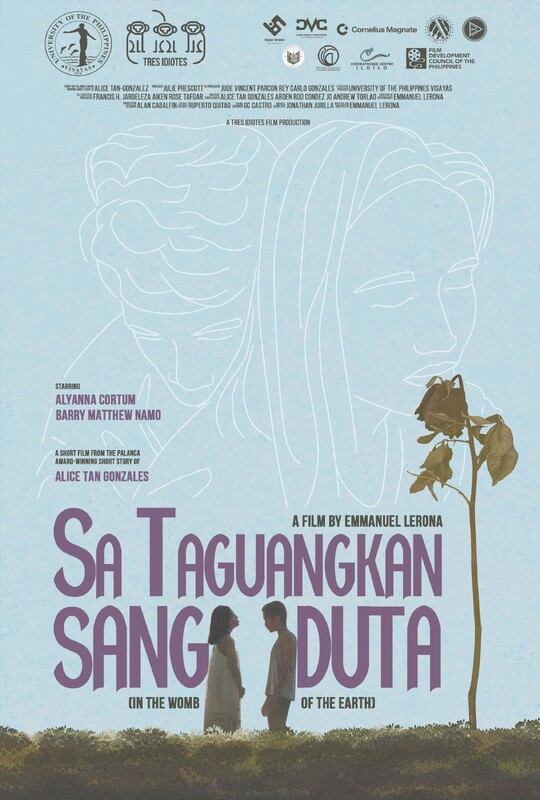
Emmanuel Lerona’s adaptation of Alice Tan-Gonzales’ 2002 Palanca first prize Hiligaynon short story “Sa Taguangkan sang Duta” (“In the Womb of the Earth”) foregrounds time and place as a woman. And this could have been easily a nostalgia about a “glorious past,” even of a future that may never come —a retro-future —but Lerona is more interested in what Gen Z calls “manifesting,” or in the language of business and innovation, “futuring.” This part, an extension of the time frame of the story, closes the short film.
The film opens in the now, a time of urgency: the decision has been made — our protagonist Elena (Alyanna Cortum) leaves Iloilo City, a place of precarious work. She goes home to the farm where her husband, Andoy (Barry Matthew Namo), lives. This movement in time and space is established with a long shot of a lonely inner highway and the dry mountain ranges of Central Iloilo. We follow Elena and Andoy up the rough road toward their house, marked by focus shots on yellowing branches and leaves of trees, the dry land, and Elena’s hands gathering dried flowers along the way. This is not your summer of bold and bright colors. This short film is set in toned earth colors of green and grey.
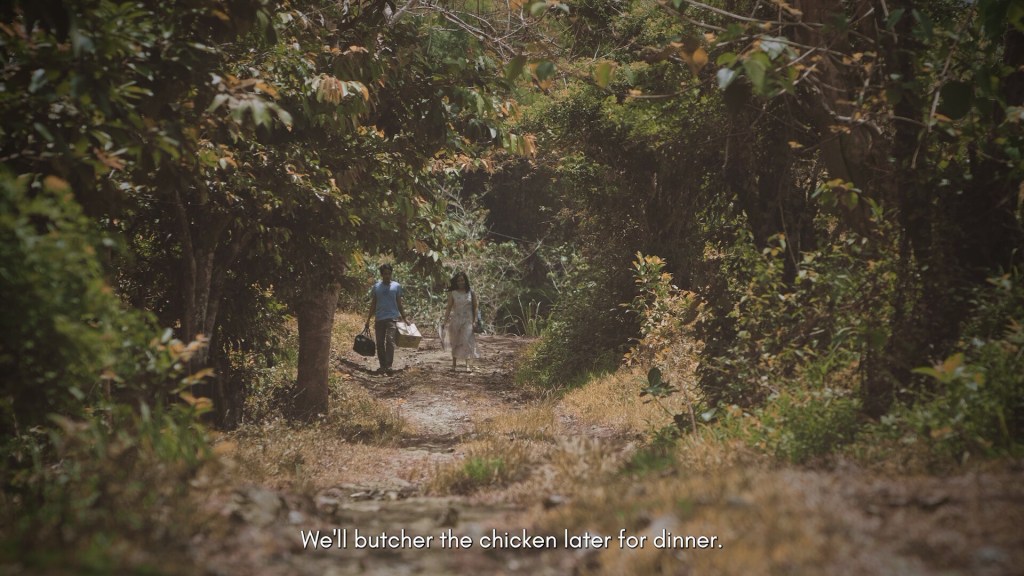
Their conversation moves forward in argument. We are introduced to another urgency: to conceive a child, a continuity of lineage for Andoy. We wonder: is Elena as barren as the land? On a trip to a waterfall, they are concerned about the declining level of water supply. This primal need to bear a child is at stake, alongside their shared survival with the land and everything in it.
Time provides the answer. Because time is not only linear but also cyclical. Night arrives on the farm and Elena notices the full moon. We know there are many myths across cultures connecting the full moon and women as the time of enhanced intuition or transformative abilities. The story operates in this trope, in this mythic time, and archetypal theme of fertility. We witness Elena’s character development: modern Elena is a memory-bearer. She remembers a distant past when her grandfather Matias practiced a farming ritual of sowing seeds during full moons, a symbolic act of making love with Mother Earth. Woman is wisdom, and from remembering, Elena acts: she convinces Andoy to do the same. This re-enactment achieves the performance of the mythical time, the co-existence of past and present in the story, which also renders the womb of the earth and Elena’s womb —two independent “organs of fire” becoming one, a mythic place. Elena watches Andoy in his glorious nakedness sow the seeds. Female gaze, female desire, toward their own lovemaking. We see fire; silhouettes.
The original story closes here, its climax. Palpable. Lerona understood this emotional core of the story that he extends with a sequence of dream-like scenes — Elena’s own myth-making: Andoy will finish college, and they will have a daughter named Stephanie. Grasses grow, seeds sprout, and blossom. This is neither essentialism nor romanticism. Only lyricism. It is clear both in the short story and in this short film that the city and the farm are in emergency status. Both are sites of struggle. The earth is burning, man and woman should strengthen their partnership. The now in its ruins is a temporal travel to the future, and with this, Lerona has made the story into a poem —a visual lyric. James Lunasco sings the original soundtrack, “San-o Ayhan.” When might it be. This is the film’s luminous longing, which is also its radical hope.
The short film was produced by Julie Prescott, edited by Ruperto Quitag, and premiered last April 27, 2024, at the UPV Cinematheque, UP Iloilo City.

 Balay Sugidanun